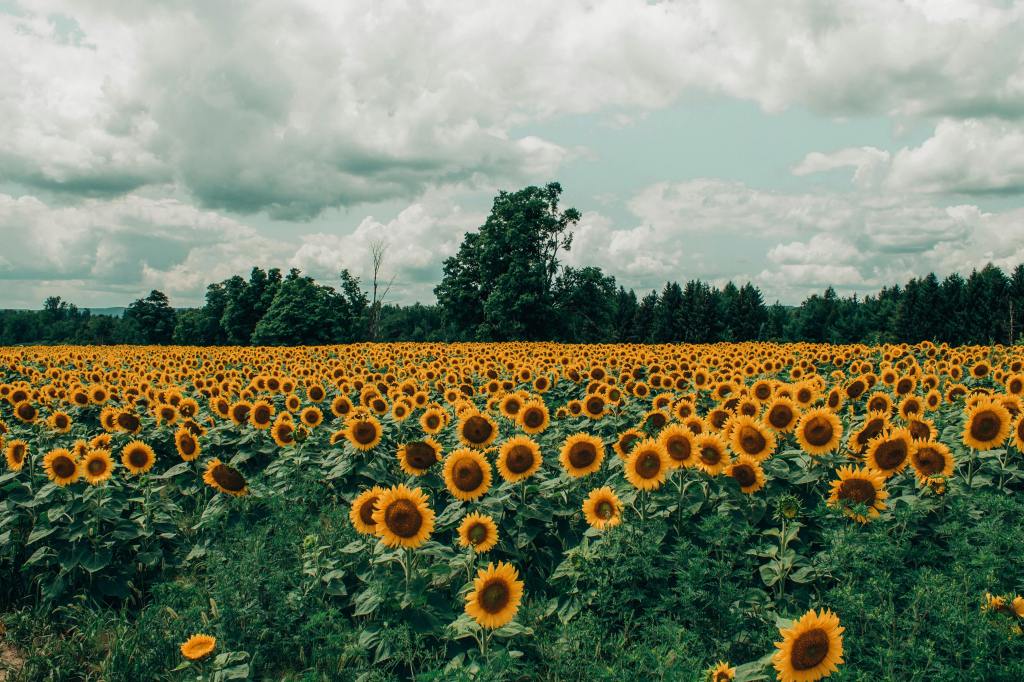
2024 has not been kind to our garden. Most of what we planted earlier in the year did not produce as well as it should. Some of that has to do with twists & turns in life that have made tending to the garden challenging and sporadic. Some of it has to do with the weather this year. And some of it, I believe, has to do with needing to recondition our garden soil.
What has grown up – big and beautiful – is a sunflower. Fun fact, what you’d recognize as ‘a sunflower’ is actually called a “flowerhead” containing two types of flowers (also known as ‘florets’). The ray florets are the bright petals that so easily characterize a ‘sunflower’, but they’re not so much individual petals as they are groups of fused petals. Meanwhile the disc florets are where the seeds are stored. Our sunflower has, at last count, seven ray florets (aka sets of petals). Wow! So of course, I have done some research to determine how & when to harvest the flowers and what to do with the seeds.
That’s where things get even better. While I had heard that sunflowers have some beneficial traits, what I didn’t know is that sunflowers are about God’s most perfect crop!
For starters, who doesn’t like sunflower seeds? You can eat them raw or roasted; they are great in salads and as a handy snack. Did you know those little seeds are packed full of Vitamin E? Vit E is an antioxidant that helps reduce inflammation, supports the immune system, protects against heart disease and stroke as well as helps protect your skin against sun damage and reduces the risk of skin cancer. In addition to Vitamin E, sunflower seeds are high in magnesium, copper, Omega-6 fatty acids and protein. These are all essential for proper health.
Sunflowers don’t just benefit humans. The flowers attract pollinators like bees and butterflies, which in turn pollinate our garden. The sunflower’s pollen contains an anti-parasitic substance that reduces the devastating infection rate in bees – which helps promote the bee population. Sunflowers also attract other beneficial insects (ladybugs, praying mantises, lacewings) that reduce the population of harmful pests.
As if all the above was not beneficial enough, the tall stalks and dense foliage make a great refuge for birds and small animals. In fact, birds such as finches, cardinals and sparrows often build nests in sunflowers! And the roots help with erosion control.
Remember how I said our garden soil may need reconditioning? Well, sunflowers are perfect for that too! Their deep roots help aerate the soil and improve drainage by breaking down organic materials, which then benefits other plants by allowing better root growth. And it gets better; sunflowers have phytoremediation properties, which means these beautiful flowers can absorb heavy metals and radiation from contaminated areas, removing environmental toxins and restoring soil health. I have no reason to suspect nuclear testing in my yard, but if sunflowers can handle radiation, I’m pretty sure they’ll be good for my garden!
Speaking of sunflower’s cleaning properties, they are fantastic air purifiers as they reduce airborne pollutants such as methane. Which, of course, brings to mind our barnyard buddies and their not-so-pleasant methane contributions! But hey, they still deserve a tasty treat every now and then. The sunflower heads can be given to our livestock once the flower has dried, with or without seeds. The stalks and foliage can also go to our pig and goats. From what I have read, neither the stalks nor the heads are completely nutritious as livestock feed; they act more as supplements so keep that in mind if you decide to treat your livestock to some sunflowers.
Once the flowers begin to droop and the petals begin to darken then I should be able to harvest the seeds. Depending on how many flowerheads we end up with, I might consider donating one or two as bird feeders. It’s actually quite easy. All you do is cut the flowerhead about a foot down the stalk and hang it upside down covering the head with a paper bag. When the flowerhead is dry, take it out of the bag and hang up for the birds! I can’t wait to see what sort of birds show up.
With all of this in mind, I’ll definitely be planting sunflowers in the garden come Spring. If you are interested in how that works out, watch this spot for future articles.

 Big Bear's Forge & Homestead
Leave a comment